
How to Get Rich: Compounded Growth
Featured Image Above from © Karen Roach @ stock.adobe.com
Compound Interest Leads to Compounded Growth
There are three primary inputs that determine long-term investment wealth: annual return, time, and initial principal. Most investors cannot realistically expect extraordinary returns, nor can they usually make a large upfront investment. What nearly everyone can control, however, is time in the market.
The longer an investment remains invested, the faster it grows—because growth itself begins to compound.
Albert Einstein famously said:
“Compound interest is the eighth wonder of the world. He who understands it, earns it… he who doesn’t, pays it.”
For most people, compound interest will be the single biggest reason they are able to retire comfortably.
A Simple Example
Consider two individuals: the conservative saver and the enlightened investor. Both work from age 25 to 65, earn an average salary of $50,000, and save 10% of their income each year.
- The conservative saver stores his $5,000 per year in cash.
- The enlightened investor contributes the same $5,000 annually to a well-managed 401(k) earning a 10% annual return, compounded tax-deferred.
After 40 years:
- The conservative saver accumulates $200,000 ($5,000 × 40 years).
- The enlightened investor amasses approximately $2.4 million.
The difference is not income, discipline, or intelligence, it is compound growth.
Understanding Compounded Growth
This is not a get-rich-quick scheme, and there is no false promise here. Over the long run, it is not your principal investment that creates wealth, it is interest earning interest.
For example, if an investor puts $100,000 to work at a 10% annual return:
- After year one, the investment grows to $110,000.
- In year two, the original $10,000 in interest itself earns another $1,000.
- That cycle repeats, year after year.
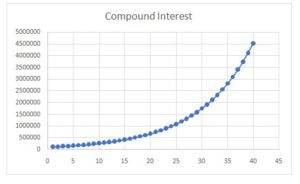
Without adding another dollar, that initial $100,000 would grow to roughly $4.5 million over 40 years.
This is how real wealth is built.
The graph below visually illustrates this concept: the longer money remains invested, the steeper the growth curve becomes. Small early gains eventually turn into exponential growth. Our free compound-interest calculators can help you run these numbers for your own situation.
A Thought Experiment
Suppose you were given a choice:
- $100,000 in cash today, or
- One penny that doubles in value every day for 30 days
Most people would choose the $100,000. That would be a mistake.
The penny would grow to approximately $10.7 million in just 30 days—all due to compounded growth.
Why Invest Using Compounded Growth
A common objection to long-term investing is, “Why wait 40 years?” The reality is that the 10% of income most people should be investing rarely makes a meaningful difference in day-to-day happiness.
Is someone earning $55,000 truly 10% happier than someone earning $50,000?
Is someone earning $100,000 twice as happy as someone earning $50,000?
Happiness is not a quantitative measure, it is qualitative. But consider this:
The individual who invested $5,000 per year instead of spending it may one day:
- Pay for a grandchild’s college education
- Provide the best possible care for a spouse later in life
- Support charitable causes they deeply care about
- Live without financial fear during retirement
Those outcomes create real fulfillment.
Final Thoughts
Two final points are worth remembering.
First, one day you will love someone more than you ever thought possible, and you will want to give them everything you can. Money isn’t everything, but it often determines whether life’s hardest moments are manageable or overwhelming.
Second, advances in medicine continue to extend life expectancy. At birth, an individual now has well over an 80% chance of living to age 60. Don’t be the only one still working at 60 with no end in sight.
Be the friend who already retired and picks up the tab for the trip around the world.
To learn more about how compound growth can help you retire earlier and with confidence, explore the rest of our blog.