


Facebook Privacy Issues – A Strong Buy Opportunity – Weekly Investments
Featured Image from © Coloures-Pic @ stock.adobe--Facebook Privacy Issues
Facebook Privacy Issues- FB A Strong Buy Opportunity
Our Weekly Investment pick of the week is Facebook. We believe the overreaction from the Facebook privacy issues market concern has created a strong buy opportunity for FB stock. Below we will discuss some of the reasons we believe why; as always, do your due diligence and form your own conclusions.
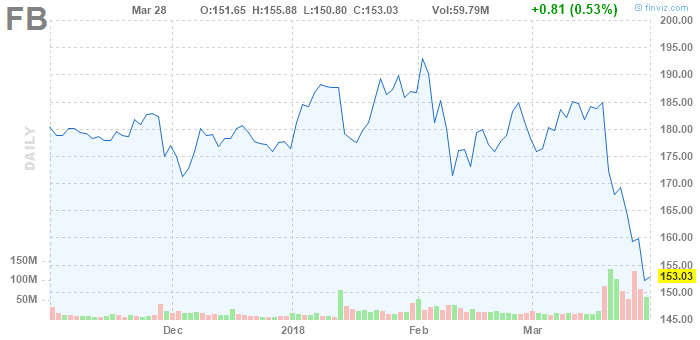
Image above from © finviz.com
Intro – Facebook Privacy Issues
Since the news first broke about the Cambridge Analytica data scandal and Facebook privacy issues, Facebook (FB) stock price has had its largest decline in nearly four years. This isn’t the first time Facebook’s business tactics have caused concern on capital hill. From its very inception in 2004 there has been controversy; to this day there are still questions on whether Facebook’s ‘founder’ and now CEO Mark Zuckerberg stole the idea of the social media giant from fellow Harvard classmates. Facebook has been plagued with a range of issues, including political controversy, data mining, inability to terminate accounts, photo recognition, employee-employer relations, child safety, hate speech, and yes, online Facebook privacy issues. These problems have resulted in FB being banned in countries such as China and have led to a significant decline in share price. Even with these past short-term price corrections, these issues haven’t stopped Facebook from plunging forward which has led to a 500%+ return over the past five years.
I was unable to find an up-to-date article which focuses on past Facebook privacy issues; yet for those of us who follow the stock, it’s apparent the social media platform experiences some type of privacy issue related event every few years. Based off historical events, there is a reoccurring pattern: the privacy issue(s) are made public, the market overreacts, Facebook apologizes, and within a few months FB stock price corrects itself. Here are a few examples of historical FB privacy issues:
- Around August 2007, Facebook’s homepage code was accidentally made public.
- In November-December 2009 Facebook launched Beacon, a software which allowed third-parties to implant a script on their website which would then send information back to Facebook on what users were doing on the third-party website. The FTC brought charges against FB for failing to keep privacy promises to its users.
- Electronic Frontier Foundation identified personal aggregation techniques called “connections” and “instant personalization” – these were both techniques which allowed user information to become public even if users didn’t agree to it.
- In 2011 Facebook launched “Tag Suggestions” a facial recognition feature which would suggest possible individuals to tag in photos.
These are all issues which resulted in heavy public scrutiny of FB and led to an overaction from investors. I see nothing noticeability different about the most recent Facebook privacy concerns which leads me to believe this is any different than past market overreactions.
Qualitative and Intangibles – Facebook Privacy Issues
Facebook continues to remain a high-growth business with elevated profit margins and significantly low debt. There are multiple intangible aspects which has led me to conclude, Facebook’s core business isn’t slowing down anytime soon.
Consumer Loyalty – Users have their entire lives posted on FB. This data is largely irreplaceable. Everything from graduation, baby pictures, family trips, birthday wishes from late relatives, etc.. It would be very difficult if not impossible to transfer all this to a new platform. In comparison, investors always talk about Apple’s business moat and ecosystem; but I’d argue, it would be much easier to switch to a Samsung instead of an Apple when it’s time for that next upgrade. Similarly, it would be easier to use Bing instead of Google the next time you search how many feet are in a mile. Both Google and Apple have moved towards personalizing user experience across their ecosystems to maintain customer loyalty and make it more difficult for users to change products. Now compare that to Facebook’s moat which a user would have to copy down and reload all videos/pictures from years worth of data while losing all their friends/tags/comments.
Market Dominance – Facebook dominates the social media market. According to statista.com, in the US alone, FB controlled 78.7% of ad revenues from social networks in 2017.
Brand Recognition – Users grown to know what to expect from FB: random rants, funny memes/videos, pictures from life events, local politics/news, etc. When a friend asks you if you know somebody, what is typically the first thing you say? “Does he/she have FB?”
Simplification of Processes – Despite being a tech company, FB doesn’t has a fairly straightforward product. I consider Facebook much like buying a newspaper 30 years ago which makes it money from ad revenue; but this newspaper includes free content creation. Just imagine if you owned a billboard which approximately 6.5 out of 10 US citizens drive by on their way to work everyday; think of the amount of ad revenue that would produce
Advertiser Loyalty – Even after this Cambridge Analytica data scandal, many analysts are predicting a minimal impact from advertisers leaving the platform. FB’s consumer base is too large for advertisers to currently find a feasible/affordable substitute.
Potential to Expand – I believe Facebook has barely scratched the surface of monetizing its platform. Just like its main competitors have displayed (Google with driverless cars and Amazon with Alexa), if a company attains a large loyal consumer base, they can easily penetrate into new industries/products. I could very well see Facebook seriously expanding its streaming services, VR, smart devices, and shopping platform in the next decade.
I believe value investors like Warren Buffet do not invest in companies like FB because of the high P/B value (5.97 according to Yahoo Finance) and limited understanding the business model. I also consider myself a value investor; that being said I do not see a large P/B or limited understanding of a fairly simple business model as reasons to refrain from such an opportunity. Although technically considered a technology company, I believe FB’s business model really isn’t too difficult to understand. The consumer base has already been built and the product has largely been developed. Proof of concept is present and user base continues to grow. So unlike other technology companies such as Apple or Microsoft, FB doesn’t have to continuously update it’s platform with new features or release a fresh physical product every six months to stay ahead of the competition.
With a profit margin of 39.2%, PEG of 0.86, and according to this article by businessinsider.com, $599k net profit per employee, these aspects make up for the fairly high P/B. Yes, I ideally prefer assets which can be liquidated if company goes bankrupt; but I also wouldn’t invest in a company if I believed it even had a remote chance of bankruptcy in the next 5-10 years.
Quantitative Reasonings – Facebook Privacy Issues
Profit Margin
A 39.2% net profit margin is amazing. So long as Facebook continues its domination within the social media industry, similar margins should continue into the foreseeable future.
Intrinsic Value and Margin of Safety
Below is my personal calculation based on Benjamin Graham’s formula; I have altered it a bit to remain conservative in my estimates. So Intrinsic Value =(EPS*(7+1*G)*4.4)/4
Data Below is from Finviz.com:
Facebook EPS= $6.16
Growth 5 year avg.= 26.9%
So (6.16*(7+1*26.9)*4.4)/4 = 229.71 Intrinsic Value
Intrinsic Value 229.71
Less: Current Price 153.16
Margin of Safety 76.55
Margin of Safety % 33.3%
I seek at least a 25% margin of safety.
Cash Flow According to CSIMarket.com
According to CSIMarket.com, as of December 31, 2017, FB had a Free Cash Flow of $17.5 billion. This is an absolutely incredible amount of cash.
Return on Equity According to Finviz
Since Facebook does not pay a dividend, I rely heavily on ROIC (preferred) and ROE. Return on equity is the amount of net income returned as a percent of shareholder equity. It illustrates how effective a company is at utilizing the cash put into the company in the form of equity. When a ROE is high, I am much less concerned about a dividend. The first reason is that I do not fall prey to double taxation (i.e. dividends get taxed). Lastly, the capital in which the company is holding on to for me is accompanied by a healthy rate of return. According to Finviz.com, FB’s ROE is 23.2%. My most ideal threshold is a ROE greater than 25% when a company is not paying out a dividend; however, with all things being considered, FB is a growing premium company which intelligently utilizes capital to fund growth. Note: 23.2% is still a very good ROE.
Debt & Leverage Ratios According to Finviz
According to Finviz.com, FB has the following:
LTD/Equity : 0
Debt/Equity: 0
Current Ratio 12.9
Per the above, there is hardly any need to be concerned about the company’s solvency. It is quite hard to go bankrupt without debt.
WACC vs ROIC According to Guru Focus
Return on Invested Capital (ROIC) vs. Weighted Average Cost of Capital is a excellent way to measure management operational efficiency/effectiveness. ROIC is essentially the return a company gets from the capital it has invested. WACC is the estimated cost of capital when taking into consideration debt and equity on a weighted average basis. If ROIC is greater than WACC, it essentially means the business earns that much more than it costs the company (company’s pays) for that capital. Conversely, if the WACC is greater than ROIC then its costing the company more to obtain that capital than the company earning from it. Gurufocus has ROIC at 51.33% and WACC at 6.6% for Facebook utilizing December 2017 data. To interpret this, this means the average cost of capital invested for FB is 6.6%. The return on this capital is 51.33%. Needless to say if I received a personal loan with an effective interest rate of 6.6% then turned around and invested that money in a piece of real estate in which I earned 51.33%, well that obviously would be an AMAZING investment.
Negative Aspects – Facebook Privacy Issues
Financial Issues
The two main financial issues I see when valuing this business is the P/B ratio and the P/S ratio.
Both of these are significantly high. The price to sales ratio according to Finviz.com is 11.25. On this particular occasion, I will consider this acceptable due to there being a profit margin of nearly 40%, a loyal consumer base, and an endless number of new opportunities. As discussed above, the P/B is concerning but the business model doesn’t require significant capital assets. Additionally, there is not a price tag which can be put on the intangibles of this company such as consumer loyalty, market dominance, brand recognition, etc.
Qualitative Issues
I believe it is not the financials or fundamentals of the business that has led FB to tank; rather I think it has to do with the qualitative and industry factors such as: The uncertainty of new regulations, possibility of fines, and the potential loss of advertisers/users. I believe the volatility of these issues will be largely short-term in nature. New regulations on data collection and privacy would have been made regardless of this breach by FB or not. FB’s actions might have expedited the updated rules but these wouldn’t have been circumvented. It is my belief that FB will adapt as always and continue to chug along. Zuckerberg is a pioneer and innovator; and true innovators continuously test the waters with new products and services. Most of these projects will fail; but for the few that do succeed, those are likely to be homeruns. Both the regulations and norms surrounding social media have not been cemented as technically we are still in its infancy. Overtime new regulations will add clarity and the norm will be established. Until then, expect major players such as Amazon, Google, Netflix, and Facebook to continue to push barriers as data collection/storage is the future of personalizing customer experiences and advertising. I believe whoever triumphs within the next decade in this single area will become the largest and most successful of them all.
Conclusion – Facebook Privacy Issues
I would rank Facebook as a strong buy with a current price point of $230. Market corrections like these bring opportunities. Do not follow the crowd when considering these Facebook privacy issues. Do the research and come to your own conclusion, as I have came to mine.
To learn more about Weekly Investments’ picks visit our blog.
DISCLOSURE: At the time of this writing, Weekly Investments and/or the contributor(s) of the content have no known positions and/or business relations in any of the stocks mentioned. Weekly Investments and the contributor(s) to the content have no plans to carry out or initiate any positions within the next 96 hours.
This article was written expressing personal opinions and in no way, in part or in whole, does Weekly Investments, its contributors, or any of their affiliates guarantee the validity and/or accuracy of the content above.
Additionally, neither Weekly Investments nor its contributors are financial advisors and this should not be taken as professional advice or instruction. It is the readers sole duty to verify information stated within and personal and/or financial decisions should not be made based upon any information gained.